AI & Productivity
The Truth About Lead Qualification: Timing Beats Everything Else
Why speed to lead is the highest-leverage input for qualification
Most lead qualification systems focus on adding more layers. More form fields, more automation, more dashboards to review later. The assumption is that if enough data is captured upfront, the right decisions will eventually follow.
In practice, the opposite is usually true.
What matters most is not how much information is collected, but when the first real interaction happens. This became clear long before AI entered the picture. In a previous company environment, a simple “speed to lead” initiative was introduced. The product did not change. The messaging did not change. The funnel stayed the same. The only difference was how quickly inbound leads were contacted.
The impact was immediate. Response rates improved. Conversations felt warmer. Sales spent less time chasing and more time closing. Nothing about the outcome was surprising in hindsight. Timing acted as a multiplier.
That same principle applies here.
When someone submits a form, there is a short window where intent is active. They remember why they reached out. They are open to a conversation. If that moment is missed, follow-ups become colder, even if the original interest was real.
Calling inside that window changes the dynamic entirely.
TL;DR
- Lead generation breaks due to fragmented workflows, not broken channels
- Speed to lead is the highest leverage input
- Voice-based qualification surfaces intent faster than forms
- Automation should reduce friction before increasing volume
- The real goal is clarity, not scale for scale’s sake
Why a Call Works When Everything Else Falls Short
An immediate call does not feel like an interruption. It feels like a continuation.
There is no need to reintroduce context or explain why the call is happening. The person already knows. That alone removes most of the friction that normally exists at the top of the funnel.
The conversation itself does not need to be long, persuasive, or polished. It simply needs to ask why the person reached out and what they are looking for. Within moments, intent becomes clear. Curiosity, seriousness, hesitation, and urgency all surface naturally when someone speaks rather than types.
Forms flatten intent. Voice reveals it.
Making Speed Reliable Instead of Aspirational
The challenge with “speed to lead” has always been consistency. Humans get busy. Calls get delayed. Follow-ups slip.
What changes here is not the principle, but the execution.
The moment a form is submitted, an automated workflow takes over. The data is cleaned and standardised first. Phone numbers are validated. Invalid or malformed submissions are filtered out before anything else happens. This step is easy to overlook, but it determines whether the system feels professional or chaotic.
Automation only works when it ignores the right things.
Once the input is valid, a call is placed immediately. Not later. Not when someone has time. Immediately.
Where Automation, Voice, and Structure Meet
Behind the scenes, each part of the system has a clear role.
The automation layer orchestrates the flow. It listens for events, applies logic, waits when needed, and decides what should happen next. This is where n8n comes in, handling the orchestration without requiring custom code.
The voice agent layer handles the conversation itself, listening and responding in real time without sounding scripted or robotic. The telephony layer connects everything to the real world, making sure calls are placed reliably and compliantly.
When the call ends, the system does not guess what happened. It waits for the outcome, checks whether the call actually connected, and distinguishes between voicemail, failed attempts, and real conversations. Each outcome is handled differently, keeping the signal clean.
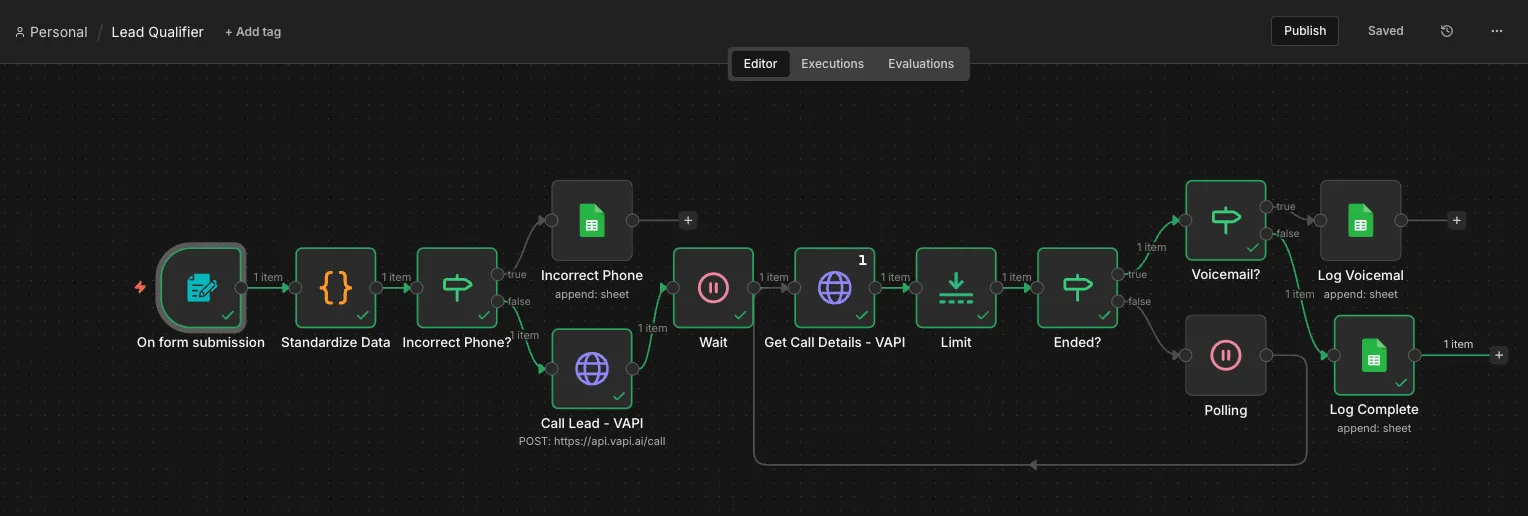
The automation workflow that validates leads, places calls, and logs outcomes
Turning Conversations into Clarity
The most valuable part of this process is not the call itself. It is what comes out of it.
Each conversation produces structured outcomes. Intent is identified. Urgency is understood. Context is captured. A clear decision emerges about whether follow-up makes sense and what that follow-up should look like.
There is no need to listen to recordings unless something feels off. There is no ambiguity about what happened. Conversations are converted into decisions instead of noise.
What Changes for Operators and Founders
The downstream effect is subtle but significant.
Sales teams no longer sift through cold or ambiguous leads. Time is spent on conversations that already have momentum. Follow-ups feel relevant instead of forced.
This is not about replacing people. It is about protecting attention.
Forms capture interest.
Calls reveal truth.
Structure creates leverage.
Frequently Asked Questions
What is this lead qualification workflow?
It is an automated system that responds to form submissions immediately by placing a phone call. The call qualifies intent in real time, capturing structured outcomes instead of relying on form data alone.
How is this different from buying lead lists?
Purchased lists are cold by definition. This workflow responds to inbound interest within seconds, while the context is still fresh. The difference is not just timing but relevance.
Do I need to know how to code to build something like this?
No. The workflow is built using visual automation tools and pre-built integrations. Configuration is required, but no custom code is needed to get it running.
Is this meant to replace manual outreach or sales teams?
No. It is designed to filter and qualify leads before they reach a human. Sales teams spend less time chasing ambiguous interest and more time having meaningful conversations.