AI & Productivity
A Practical Lead Generation Workflow for Small Businesses
An experimental workflow for reducing friction in cold outreach
Cold email is not a new idea.
Lead generation is not a new problem.
Yet for many small businesses and freelancers, getting consistent leads still feels harder than it should.
Not because the channel is broken.
But because the workflow behind it usually is.
I didn’t build this workflow because I had lead generation figured out. I built it because I didn’t.
Every attempt felt fragmented.
Search here. Copy there. Guess an email. Lose momentum.
So instead of trying to optimise outcomes, I ran a simple experiment.
What would a lead generation workflow look like if it were designed from scratch today?
Not to scale aggressively. Not to blast inboxes. Not to promise results.
But to reduce friction.
This post documents that experiment.
TL;DR
- Lead generation fails because the workflow is fragmented, not because the channel is broken
- This workflow uses Apify for data collection and n8n for automation logic
- Three stages: data intake, email discovery, and tracked outreach
- Cold email is the last step, not the starting point
- The goal is reducing friction, not scaling volume
Why Lead Generation Breaks for Small Businesses
Most small businesses don’t struggle because they lack effort.
They struggle because lead generation is fragmented.
Searching for businesses. Copying data into spreadsheets. Guessing email addresses. Tracking outreach manually.
When every step is disconnected, consistency disappears.
The Real Problem Is Workflow, Not Effort
Cold email doesn’t fail because it no longer works.
It fails because time is spent on low-yield actions.
A small number of high-leverage steps drive most outcomes. Everything else creates drag.
This experiment was about designing around that idea.
How the Workflow Is Structured
The workflow is intentionally simple.
It is divided into three stages. Each stage does one job. No step tries to be clever.
The following diagram shows the complete lead generation workflow built using Apify and n8n.
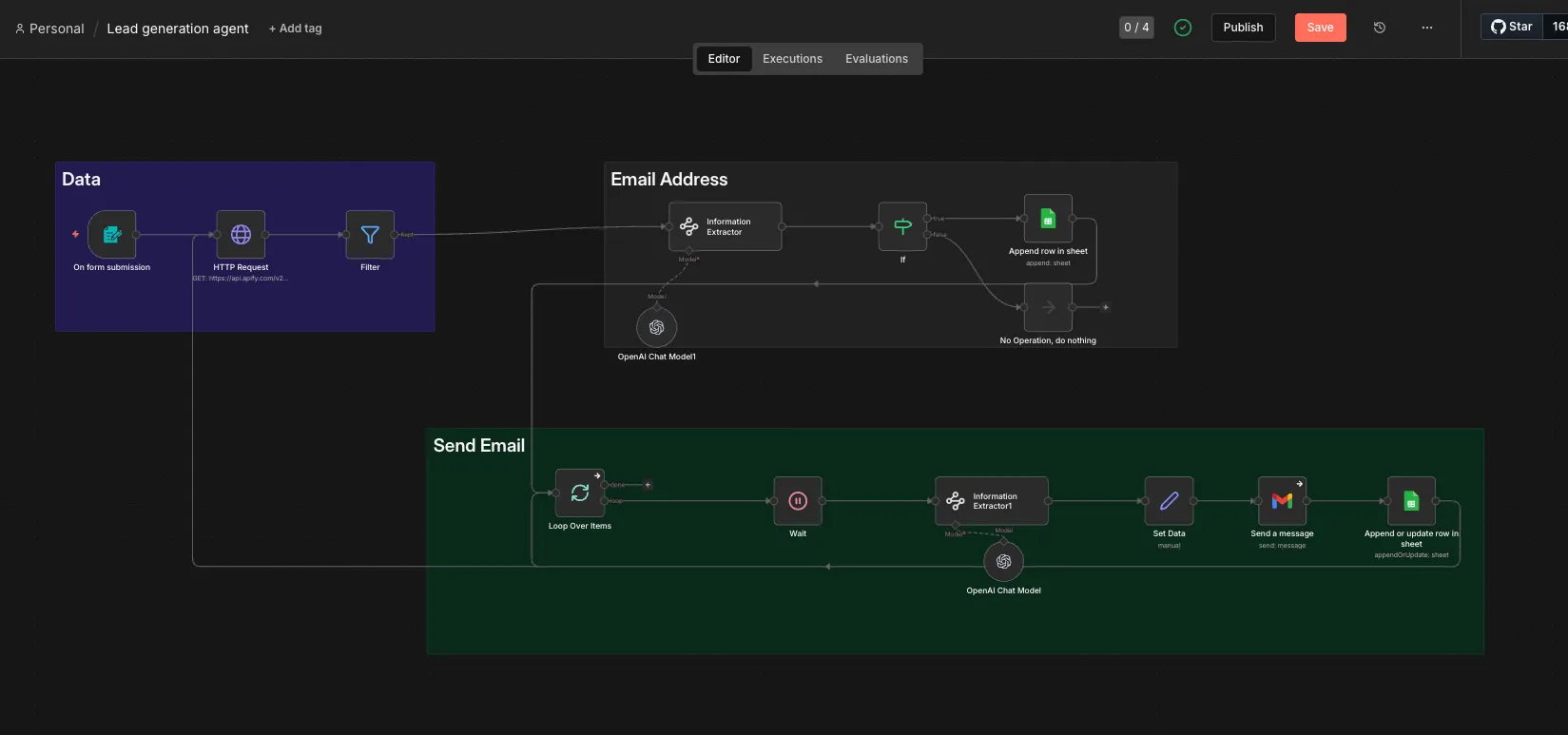
Lead generation workflow built using Apify and n8n
Data Intake
The workflow starts with structured business data.
That data can come from scraped listings, forms, or spreadsheets.
At this stage, nothing is enriched. Nothing is emailed.
The goal is a clean starting point.
Email Address Discovery
Once business data exists, the workflow attempts to find a usable email address.
It visits the business website, extracts visible contact information, and interprets page content.
AI is used to read, not invent.
If no usable email is found, the workflow stops. No email is better than a bad email.
Send Email and Log Activity
Only validated leads reach this stage.
The workflow loops through approved contacts, applies a short wait between sends, prepares a simple personalised email, sends the email, and logs the action for tracking.
Every send is traceable.
Why Apify and n8n
Apify handles web data collection. n8n handles logic and automation.
Together, they allow small businesses to build transparent systems without relying on black-box SaaS tools. This is similar to how I approach building production-ready automations for other business processes, or how you might build an AI discount finder that monitors prices without subscribing to newsletters.
Everything is visible. Everything is adjustable.
Cold Email Comes Last
Cold email is the final step. Not the starting point.
By the time an email is sent, the business is relevant, the email exists publicly, duplicates are removed, and context is preserved.
Selectivity matters more than volume.
What This Is Not
This is not a spam machine.
It does not promise replies. It does not replace thinking.
It removes friction so thinking becomes possible.
This workflow started as a personal experiment. If building real AI systems instead of chasing tools sounds useful, I occasionally share notes on automation, workflows, and systems thinking for marketing and revenue teams.
Final Reflection
This workflow is an experiment.
Only a system designed to be simple enough to run consistently.
If lead generation feels heavy, the problem is usually the workflow.
This is one way to rethink it.
Frequently Asked Questions
What is this lead generation workflow?
This is an experimental automation workflow designed to help small businesses and freelancers prepare leads for cold outreach by reducing manual work and guesswork.
How is this different from buying lead lists?
Lead lists are static and often outdated. This workflow pulls data directly from public sources and makes the process transparent and repeatable.
Do I need to know how to code to build this?
No. The workflow uses visual tools like Apify and n8n. Clear thinking matters more than coding.
Is this meant to replace manual outreach?
No. The workflow handles structure and preparation. You still control messaging and judgment.